Tag: poetlife

  • Minha Jornada de Escrita: Superando Desafios

    Minha Jornada de Escrita: Superando Desafios

    Você se lembra da sua vida antes dos sete anos? Você se lembra do que queria ser quando crescesse?

    A woman with curly hair holds a laptop in one hand and a feather pen in the other, surrounded by books, a cup of coffee, and digital icons representing technology and creativity, set against a city skyline at dusk.

    Eu queria ser escritora.

    Eu queria me conectar com as pessoas por meio do poder das palavras. Eu queria compreender — e ser compreendida.

    Sou disléxica, então esse sonho parecia praticamente impossível. Mas ainda assim era o meu sonho. Eu brincava de ser escritora. Fing ia ser autora. Fazia lançamentos de livros imaginários e sessões de autógrafos, dava autógrafos para leitores invisíveis no quarto da minha infância.

    Depois eu cresci e ouvi todas aquelas coisas de sempre. Faça outra coisa. Livros não vendem. Ninguém vai ler o que você escreve. Pare de sonhar acordada. Tira isso da cabeça.

    Então eu não me tornei escritora. Pelo menos não oficialmente.

    Virei assistente corporativa de um CEO do setor de hospitalidade e, muitos anos depois, economista.

    A vida ficou corrida e difícil. Nunca tive tempo para escrever um livro inteiro. Mas nunca parei de escrever. Eu escrevia em guardanapos, em cadernos, em pedaços de papel enfiados em bolsas e gavetas. O fio sempre esteve ali, me puxando de volta para mim mesma, e eu continuava dizendo “depois”.

    Depois, quando eu tiver tempo.
    Depois, quando a vida estiver mais calma.
    Depois, quando eu tiver permissão.

    Em vez disso, eu me mantive ocupada. Trabalhos corporativos. Longas jornadas. Comprando coisas de que eu não precisava, tentando preencher um espaço que não queria ser preenchido. Ele queria escuta.

    Então a COVID aconteceu. Minha carreira na hospitalidade parou da noite para o dia. Tudo ficou quieto. Lockdown. E nesse silêncio, eu consegui me ouvir de novo. Comecei a escrever — não para um público ou um resultado — apenas para ficar perto de mim mesma. Nunca me senti tão eu quanto naquele período.

    Alguns meses depois, fui diagnosticada com câncer de mama.

    A urgência apareceu, e eu escutei. Ela me perguntou se eu realmente ia deixar esta terra sem fazer as coisas que sempre quis fazer. Eu disse que não. Disse que faria tudo o que pudesse com o tempo que tivesse.

    Foi aí que a minha vida de verdade começou, aos 38.

    O câncer ficou comigo, indo e vindo como bem entendia. Ele mudou a forma como eu vejo o tempo. Forçou perguntas que eu não podia evitar. O que você deixa para trás? O que ficou inacabado? O que ainda quer ser dito?

    Então eu escrevi mais. Porque tinha medo de desaparecer sem deixar algo para trás. Algo para pessoas como eu. Pessoas neurodivergentes. Pacientes com câncer. Ou você — o leitor que eu imaginava quando era menina.

    Eu escrevi o livro. Entre cirurgias, sessões de quimioterapia e radioterapia.

    Eu escrevi o livro, e meu momento de maior orgulho veio em junho de 2025.

    Ele foi publicado.

    Mas você não veio… pelo menos ainda não.

    Talvez você esteja lendo isto no futuro.
    Talvez você esteja aqui agora, e isso é o que importa.
    Talvez você leia meu livro, ouça minha voz e encontre uma companhia que possa viajar no seu bolso.

    Venha passar 154 páginas comigo e, quem sabe, você aprenda um pouquinho sobre si mesmo ao longo do caminho.

    Não se esqueça de pegar um doce e uma xícara quente de chá ou café — e, por favor, sirva uma para mim também, porque estarei bem aí com você, e eu amo café.
    (Já consigo sentir o aroma!)
    @lbfisher

  • From Dreams to Reality: A Writer’s Introspection

    From Dreams to Reality: A Writer’s Introspection

    Do you remember your life before you were seven years old? Do you remember what you wanted to be when you grew up?

    A woman with curly hair holds a quill pen in one hand and a laptop in the other, surrounded by books and a cup of coffee. The background features icons representing technology and creativity, set against a city skyline at dusk.

    I wanted to be a writer.

    I wanted to connect with people through the power of words. I wanted to understand and be understood.

    I’m dyslexic, so that dream felt pretty impossible. But it was still my dream. I played writer anyway. I pretended to be an author. I held imaginary book launches and book signings, gave autographs to invisible readers in my childhood bedroom.

    Then I grew up and heard all the usual things. Do something else. Books don’t sell. No one will read what you write. Stop daydreaming. Get that out of your head.

    So I didn’t become a writer. At least not officially.
    I became corporate assistant to a hospitality CEO, and many years later, an Economist.

    Life got busy and hard. I never had time to write a full book. But I never stopped writing. I wrote on napkins, in notebooks, on scraps of paper shoved into bags and drawers. The thread was always there, pulling me back to myself, and I kept saying later.

    Later, when I had time.
    Later, when life was quieter.
    Later, when I was allowed.

    I stayed busy instead. Corporate jobs. Long hours. Shopping for things I didn’t need, trying to fill a space that didn’t want filling. It wanted listening.

    Then COVID happened. My hospitality career stopped overnight. Everything got quiet. Lockdown. And in that quiet, I could hear myself again. I started writing—not for an audience or an outcome—just to stay close to myself. I’ve never felt more like me than I did then.

    A few months later, I was diagnosed with breast cancer.

    Urgency showed up, and I listened. It asked me if I was really going to leave this earth without doing the things I always wanted to do. I said no. I said I would do everything I could with whatever time I had.

    That’s when my real life started, at 38.

    Cancer stayed with me, coming and going as it pleased. It changed how I see time. It forced questions I couldn’t avoid. What do you leave behind? What’s unfinished? What still wants to be said?

    So I wrote more. Because I was afraid of disappearing without leaving something behind. Something for people like me. Neurodivergent people. Cancer patients. Or you—the reader I imagined when I was a little girl.

    I wrote the book. Between surgeries, chemo, and radiation appointments.
    I wrote the book, and my proudest moment came in June 2025.

    It was published.

    But you didn’t come… at least not yet.

    Maybe you’re reading this in the future.

    Maybe you’re here now, and that’s what matters.

    Maybe you’ll read my book, hear my voice, and find a little companion worth keeping, and that can travel in your pocket.

    Come spend 154 pages with me, and maybe you will learn a little bit about yourself along the way.

    Don’t forget to grab a pastry and a hot cup of tea, or coffee, and please serve me one too—because I’ll be right there with you, and I love coffee.
    (I can smell the aroma already!)


    @lbfisher

    Luciana Fisher

  • Respect Is Not Given—It’s Enforced.

    We must teach people how to treat us and respect our boundaries.

    We teach people how to treat us. Not with words, but with what we allow, what we tolerate, and what we excuse.

    How many times have you let a snide comment slide, swallowed disrespect like a bitter pill, convinced yourself it wasn’t that bad? How many times have you stayed silent when someone crossed a line—hoping, maybe, that next time they wouldn’t?

    The truth? Next time, they will. Because you taught them that they could.

    But here’s the shift: You are not a prisoner in someone else’s narrative. You are not obligated to endure mistreatment. You don’t need to beg for respect—it’s not a request, it’s a standard.


    A Hard Lesson: My Friendship with D.

    For over ten years, I had a friend—let’s call her D.—who mastered the art of guilt-tripping.

    She had a toddler, so therefore she constantly complaining of having the weight of the world on her back, and an endless list of reasons why I had to help her. Her struggles were always bigger than mine. Her needs always more urgent. If I ever hesitated, she reminded me: “If you were a real friend, you’d help me,” “I have no friends,” “I always help people, no one helps me.”

    “So, I did. I wrote, corrected or revised her college assignments. I prioritized her needs over my own. I let her dictate the rules of our friendship. And for a decade, I lived under one unspoken truth:

    I was only as good as my latest ‘Yes.’

    The moment I finally said No? She called me every name under the sun. The mask dropped. I wasn’t a friend—I was a resource. And when I stopped being useful, I stopped being valued.

    That was the day I broke free. And the peace that followed? Worth every painful lesson.


    Three Hard Truths About Disrespect

    Awareness Is Your Superpower
    Every time you tolerate disrespect; you are silently approving it. People will treat you in the way you show them they can. The moment you become aware of the patterns you’ve allowed is the moment you begin to break them.

    You Are Not Trapped
    No relationship—friendship, family tie, workplace dynamic—is worth your dignity. You are allowed to walk away. You don’t owe anyone your silence in the face of mistreatment.

    Boundaries Are Not Negotiations
    If you say no and then cave when someone pressures you, you’re training them to ignore your limits. It is the same positive reinforcement we use when training dogs. A boundary is only as strong as your commitment to enforcing it.


    How to Start Taking Your Power Back

    Identify the Subtle Signs of Disrespect

    • Do they dismiss your feelings?
    • Do they make you feel guilty for prioritizing yourself?
    • Do they only value you when you’re useful to them?

    Use These Boundary-Setting Phrases

    • “No.” (No explanation needed)
    • “I can’t do that.” (No explanation needed.)
    • “I won’t be able to help you with that.”
    • “I don’t allow people to speak to me that way.”
    • “That doesn’t work for me.”

    Prepare for the Pushback
    When you stop being a pushover, people who benefited from your silence will push back. Let them. Their reaction is proof that the relationship was one-sided. Don’t waver. Cut them off if you have too. You are better off without them.


    The Commitment We Owe Ourselves

    Respect is a mirror—if you don’t hold it up, people will reflect back whatever suits them. So, here’s the challenge:

    What’s one commitment you will make to teach people how to treat you better?

    Write it down. Say it out loud. Share it with someone who will hold you accountable.

    Because the truth is, respect isn’t something we wait for—it’s something we demand. Of ourselves and for ourselves.

    Do you communicate and honor your boundaries?

    Drop your commitment in the comments. Let’s hold each other accountable.

    With Ink, Fire & Rebellion,

    Luciana

    Leave a comment

    Share

    To receive new posts and support my work, consider becoming a free or paid subscriber. Subscribed

  • Words that Challenge: Voices Against Censorship

    Words that Challenge: Voices Against Censorship

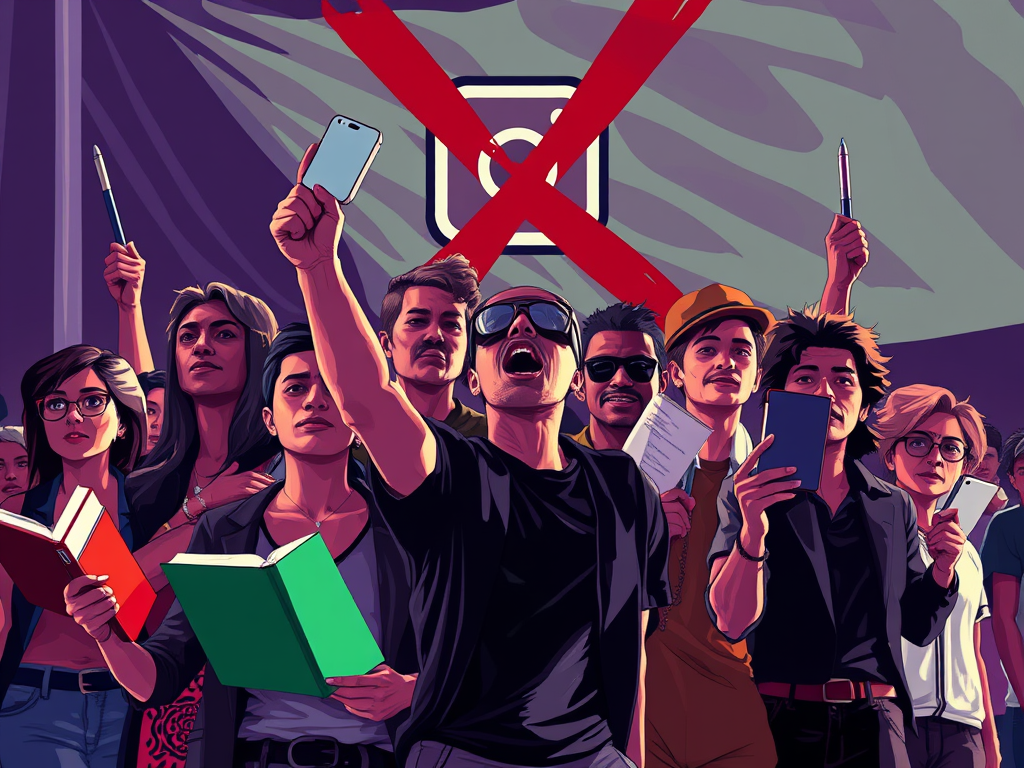
    Words are weapons—I wield mine with purpose.

    Since when thought-provoking poetry became a crime?
    Some words are meant to challenge, to unsettle, and to hold a mirror up to the world. This is one of those instances.

    I didn’t expect the overwhelming support when sharing these poems. But I welcomed the wave of likes, comments, and shares these pieces got. These interactions led to a rise in my follower count. Then, unexpectedly, Instagram restricted my account and silenced my voice to “protect the community”.

    Protect the community from poetry?

    So much for freedom of speech. So much for art having a space.

    Please read below the poems that led to my Instagram account being restricted and share your thoughts. Don’t forget to like, comment, tag, and forward this—whatever you can do to help. I believe these poems need to reach a wide audience, especially since there are efforts to censor them.

    These are my call to action. Let me know your thoughts in the comment section.

    “To the Overlords” – Part I

    -by Luciana Fisher.

    To the overlords of this world—

    the hollow men and women,

    with full bellies—but still insatiable in their hunger—

    gorging at the top,

    looking down at the people—

    below.

    The hollow men and women,

    hoarding bullion, machinery, land, and toys—

    Shoving it all—into the echo chambers of their privilege—

    A spectacle of excess.

    A competition of greed.

    The have-nots crushed—by the deliberate thrusts of their overlord’s hips—

    Hollow men—and women.

    Pitiful men, and women,

    coddling their insecurities—

    As mothers and fathers’ struggle

    to nurture their emaciated children,

    Praying for mercy—

    to overlords who believe themselves chosen—

    Favored. Anointed by God—

    A God they do not believe in.

    The architects of decay,

    gallivanting across our screens,

    Vultures draped in fine cloth.

    Creatures of hell.

    Signing and lobbying into law—

    only what lines their pockets.

    Eating organic—gold

    off their plates,

    Feeding the void, the parasite inside,

    mistaking it for a soul.

    Feasting. Parading in shallow fashion.

    Poisoning oceans.

    Drowning rivers in oil.

    Dissolving democracy.

    Displacing millions with the stroke of a pen.

    To the hollow men and women—

    the despicable, the deplorable—

    Those who think of themselves Kings and Queens,

    believing their flesh won’t rot like the rest of us.

    To the overlords of this world,

    to you, we raise our empty glasses.

    Cheers.

    Cheers!

    To your greed—

    may it rot alongside you,

    When you inevitably join us—

    six feet underground.

    “To the Overlords” – Part II

    -by Luciana Fisher

    To the Overlords of this world—

    The families and CEO’s hoarding all the bullion,

    and the means of production.

    With their grip tight

    around Mother Earth’s neck,

    giving it an unfair shake—

    while skillfully squeezing the balls of the charging bull,

    getting drunk on the capital—

    marginal gain of its cumbersome milk.

    Manipulating markets.

    Widening the gap.

    Seeking to patent even the air we breathe.

    Colluding to push down our throats

    the potions they call medicine—

    to heal us from the poison they fed us.

    So we clock in on time,

    and remain in need of overtime,

    while they enjoy their favorite pastime—

    Inflicting pain for their gain.

    Believing themselves saints

    for allowing us to play a part in their game.

    Cramping us in cabins.

    Bringing down planes.

    Taxing fees

    for their beloved interests—

    While we bleed

    through our hands and feet

    to support their greed.

    _________________________

    To the overlords of this world—

    hollow men and women—

    Stripping us of our human rights.

    Removing our women’s choice and birth rights.

    Kneeling on our necks,

    knowingly breaking our backs—

    while spending our pension checks.

    _________________________

    To the overlords of this world—

    hollow men and women,

    Who believe themselves safe,

    resting in the ivory tower of their power—

    _________________________

    Make no mistake.

    We are coming for you.

    Protect your food.

    Watch your backs.

    Sleep with your eyes open.

    Do not take a sip of water—

    without fear.

    Know.

    That now—

    We are the hunters.

    You— the prey.

    We are—the ninety-nine—percent,

    rising up to strike down—

    the one.


    How do you feel about these poems?

    Have you ever had your art, words, or content restricted?
    Do you think creative license still exists, or is it only granted when it’s profitable? Let’s talk about it—drop your thoughts in the comments.

    With Ink, Fire & Rebellion,

    Luciana